Top 7% vetted

Forward deployed engineers

Embed an engineer who builds AI into your real systems, from the first discovery call to production rollout. The role every AI company is racing to hire, matched to your team from the top 7 percent in 72 hours.

Hanna S., forward deployed engineer
Hanna S.Top 7% vetted
Forward deployed engineer
Tech stack
PythonSnowflakeDatabricks
Owns

Works inside your real workflows

Feeds lessons back into your roadmap

Lukas W., forward deployed engineer
Lukas W.Top 7% vetted
Forward deployed engineer
Tech stack
AgentsEvalsGCP
Owns

System design and the build

Turns stalled pilots into shipped systems

Marko V., forward deployed engineer
Marko V.Top 7% vetted
Forward deployed engineer
Tech stack
PythonTypeScriptAWS
Owns

Embeds in your environment

Owns the last mile into production

Matched in 72hrs

Talent vetted across 500+ data points to the top 7 percent. Trusted by 1,500+ teams.

Skyscanner
IKEA
Bolt
HelloFresh
iHeart
Mastercard
In short

A forward deployed engineer is a senior engineer who embeds inside your company and builds AI into your real systems, from the first discovery call through to production. Unlike a consultant, who advises, or an agency, which delivers at arm's length, a forward deployed engineer works in your environment, with your data and your workflows, and owns the last mile. Pangea.ai matches you with one from the top 7 percent in 72 hours.

The role

What a forward deployed engineer owns in your business

An embedded engineer takes the whole path from idea to production off your plate, and stays accountable for it.

They start with discovery: what the AI needs to do, which systems it has to touch, and where your data actually lives. They turn that into a technical scope you can sign off, then design and build it inside your environment rather than in a sandbox that looks nothing like it. They handle the integration work that quietly kills most pilots, your authentication, your data pipelines, your permissions, your legacy service that nobody wants to touch. They take it through evaluation and rollout, and they stay for the part where real users break it.

Then they feed what they learned back to your team, so the second AI project is faster than the first.

The practical test of whether you need one: if your blocker is deciding what to do with AI, you need a fractional AI leader. If your blocker is that something half-built is not in production, you need a forward deployed engineer.

For the full background on where the role came from and how it differs from a solutions engineer or a consultant, read our explainer on what a forward deployed engineer is.

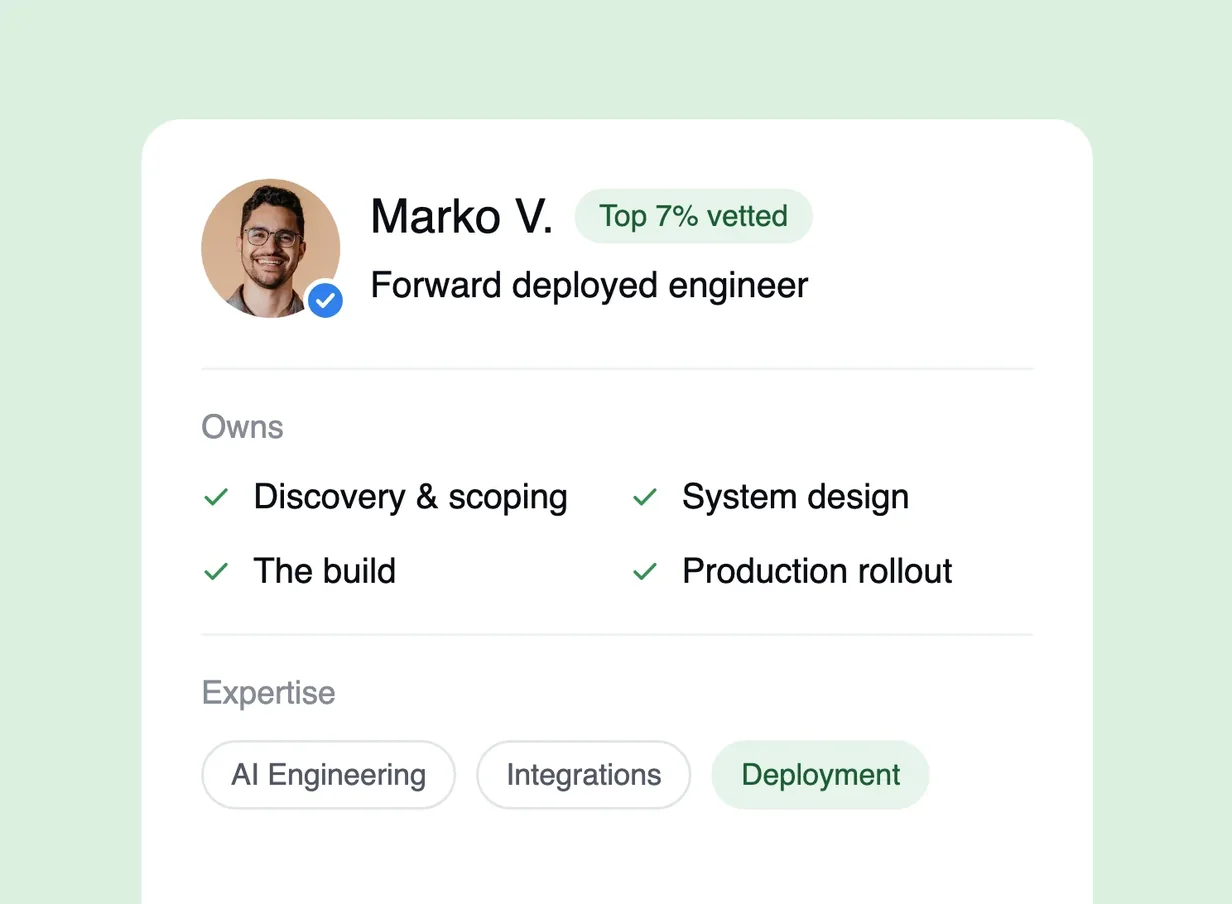
Marko V., a forward deployed engineer, Top 7% vetted: owns discovery and scoping, system design, the build and production rollout. Expertise in AI engineering, integrations and deployment.
The market

Why every AI company is hiring forward deployed engineers

The forward deployed engineer has become the most sought-after role in AI, for a simple reason: even the best model returns nothing until someone builds it into a real business.

The largest platforms moved first and they moved with real money. In June 2026 AWS committed $1 billion to a new Forward Deployed Engineering organization. Weeks later Microsoft launched Microsoft Frontier Company, a $2.5 billion business built around roughly 6,000 embedded engineers. Palantir popularized the pattern, and OpenAI and Anthropic now hire for it directly.

The hiring market shows the same thing from the demand side. Indeed lists more than 5,400 forward deployed engineer roles, LinkedIn more than 11,000 in the United States alone, and startup.jobs puts the median salary at $189,647 across nearly 2,000 postings. Searches for the role have gone from 8,100 a month to roughly 40,500 in a year.

Demand has outrun supply, which is exactly why hiring through a vetted network beats a cold search. You get an embedded, production-ready engineer in days instead of spending months looking for a profile that barely exists yet.

Compare the roles

Forward deployed engineer, AI engineer, or solutions engineer?

The titles overlap in job ads, so here is the difference that matters when you are the one hiring.

RoleWhat they are forWhen to hire one
Forward deployed engineer.This pagebuilding AI into your live systems and owning the path to production.a model, a pilot or a prototype exists and it is not in production.
AI or ML engineer.building and training the models and pipelines themselves.the modelling work is the hard part, and integration is already handled.
Solutions engineer.fitting an existing product to a customer, usually before the sale.you are the vendor, not the buyer.
AI consultant.assessment, strategy and a roadmap.you need to decide what to do before anyone builds it.

A forward deployed engineer is the only one of the four who is accountable for something working in your environment at the end. For the detailed comparison, including sales engineers and the role's history, see what a forward deployed engineer is.

Cost

What a forward deployed engineer costs

Cost is the first question most teams ask, so here are the market numbers before you talk to anyone. These are third-party benchmarks to budget against, not Pangea.ai quotes.

  • Embedded contractor:

    about $125 to $250 an hour.

    The engineer, scoped to your engagement, scaling down when the work does.

  • Packaged engagement:

    around $95,000 for a 12-week build.

    A defined outcome with a start and an end.

  • Full-time hire:

    roughly $220,000 to $400,000 a year fully loaded.

    A permanent seat, plus the search.

Published salary data puts the role between $162,000 and $350,000, with a median of $189,647 across nearly 2,000 US postings, and recruiters advertising $190,000 to $235,000 plus equity. That is the number a cold hire has to clear, before a search that typically runs months. An embedded engagement gets you the same seniority in days and ends when the work does.

For the full picture across every engagement model, see AI talent pricing, or book a consultation for a number built around your scope.

First 90 days

What your engineer ships in the first 90 days

Embedding an engineer is not an open-ended retainer. Here is the shape most engagements take.

Weeks 1 to 2: discovery and a scope you can sign off.

Your engineer maps the systems, the data and the constraints, then writes the technical scope: what gets built, what it integrates with, how success is measured. If the honest answer is that the project needs a different shape, you find out here rather than in month four.

Weeks 3 to 8: build inside your environment.

They work in your stack, with your data and your permissions, shipping in increments you can see. Integration work gets handled as part of the build rather than discovered at the end, which is where most AI pilots stall.

Weeks 9 to 12: production, evaluation and handover.

The system goes live for real users, with evaluation in place so you can tell whether it is working. Your engineer documents what they built and walks your team through it, and you decide whether to extend, scale into an AI Pod, or stop.

Timelines move with scope. What does not change is that you get a scope you approved in the first two weeks and something in production by the end.

Three ways to staff AI work

Forward deployed engineer, fractional leader, or AI Pod?

An FDE is one of three ways to staff AI work at Pangea.ai. Here is when each fits. All three come from the same applied AI talent network, and if you would rather hand over the whole build, see our AI development services.

Forward deployed engineer

You needAn engineer to build AI into your systems and ship it

  • Why: Hands-on, embedded, owns the last mile from discovery to production.
This page
Fractional AI leader

You needSenior AI strategy, governance, and ownership part-time

  • Why: Direction and accountability, not hands-on build.
Fractional AI leader
AI Pod

You needA whole team to deliver an AI build end to end

  • Why: A dedicated AI delivery team, often built around an FDE.
AI Pod

Not sure which you need? Describe your project and our Talent Orchestration maps the options, then you choose.

How it works

Hire a forward deployed engineer in 72 hours

Tell us what you need and start reviewing forward deployed engineers within days.

  1. 01

    Tell us what you need

    share the systems, the AI outcome, and the domain.

  2. 02

    Get matched in 72 hours

    review a shortlist of forward deployed engineers from the top 7 percent.

  3. 03

    Start building

    interview, choose, and embed your forward deployed engineer in your environment.

Testimonials

Hundreds of enterprises & SMBs trust Pangea.ai

Leading startups and enterprises worldwide trust Pangea.ai with their most important product initiatives.

5 out of 5 stars
Our engagement with Pangea.ai has significantly improved the delivery quality of our innovations.
Pete Becker
Product Manager Lead
We worked with the Pangea.ai team to identify a mobile engineering partner to help with our iHeartRadio for auto roadmap.
Tom Drapeau
VP of Engineering
Pangea.ai connected us to various innovation partners around the world.
Ayne Santiago
Software Engineer
Pangea.ai is a wonderful partner for any early-stage startup who is eager for top-tier engineers to accelerate their roadmap.
Jeff Hu
Founding Engineer
Pangea.ai offers a fantastic service for high-growth businesses. Their expertise saved us a significant amount of time and risk.
Paul Skidmore
Product Lead
Working with Pangea.ai was an awesome and pleasant experience. We got exactly what we needed and more.
Javy Olives
Enterprise Product Head
Get started

Hire a forward deployed engineer, matched in 72 hours.

Embedded, vetted, building AI in your systems within days. Tell us what you need and start reviewing candidates fast.

Frequently asked questions

Forward deployed engineer FAQ

Here are some of the most common questions we get, all ready for you.

Tell us your systems and the AI outcome you need, get matched within 72 hours from the top 7 percent, interview, and embed them in your environment.

An engineer embedded in a customer's environment who builds and ships software, usually AI, inside real systems. Our full explainer covers the role in depth.

Palantir popularized the role, and OpenAI, Anthropic, Ramp and Salesforce hire for it. In 2026 AWS and Microsoft each built large forward-deployed organizations. More on the role's history.

Market benchmarks put embedded contractors at roughly $125 to $250 an hour, with fully loaded full-time hires at $220,000 to $400,000 a year. Pangea.ai prices per engagement: see AI talent pricing or book a consultation for your number.

An AI or ML engineer builds the models and pipelines. A forward deployed engineer gets them into your production systems and owns the integration, the rollout and the last mile. Teams shipping their first AI feature usually need the second one.

A solutions engineer fits an existing product to a customer, usually before the sale. A forward deployed engineer embeds and builds custom solutions inside your environment. See the full comparison of FDE versus solutions engineer.

You are matched within 72 hours, with pitches often inside 24.

Yes. Embedding in your environment and working with your real data and workflows is the defining trait of the role.

Yes. Engagements are scoped per need: a few days a week, a fixed-term build such as a 12-week project, or full-time embedded. You are not signing up for a permanent seat.

Both. "Embedded" means inside your systems and your team's workflow, not necessarily in your building. Most engagements run remotely with on-site time where it earns its keep, and you can filter for time zone when you review your shortlist.

Handover is part of the job. Your engineer documents what they built and walks your team through it, and feeding lessons back into your roadmap is one of the defining traits of the role. If you want continuity afterwards, the same engineer can anchor an AI Pod.

If you need a single specialist, hire an FDE. If you need a team to own delivery, an AI Pod built around an FDE may fit better.

Are you a forward-deployed engineer? Join Pangea's talent network →